
What Probate Covers in Marion County
Marion probate matters are handled by the Probate program or division of Marion County Circuit Court. Oregon does not route these local matters to a separate Surrogate's Court or Orphans' Court. Probate covers estates, wills, guardianships, conservatorships, protected-person property, fiduciary duties, inventories, accountings, notices, and final orders.
The official probate page links users to court forms and statewide filing fees. Questions about probate policy and procedure go to the probate department at 503-588-5141. Copies of filed probate documents are requested through the Circuit Court Records Department, usually with the case number and exact documents needed.
Marion County Circuit Court Probate Division
100 High St. NE
Salem, OR 97301
Probate department: 503-588-5141
Records Department: 503-588-5101
Monday-Friday, 8:00 a.m.-5:00 p.m., excluding holidays
The Marion County Circuit Court probate page is the local starting point for probate program information.
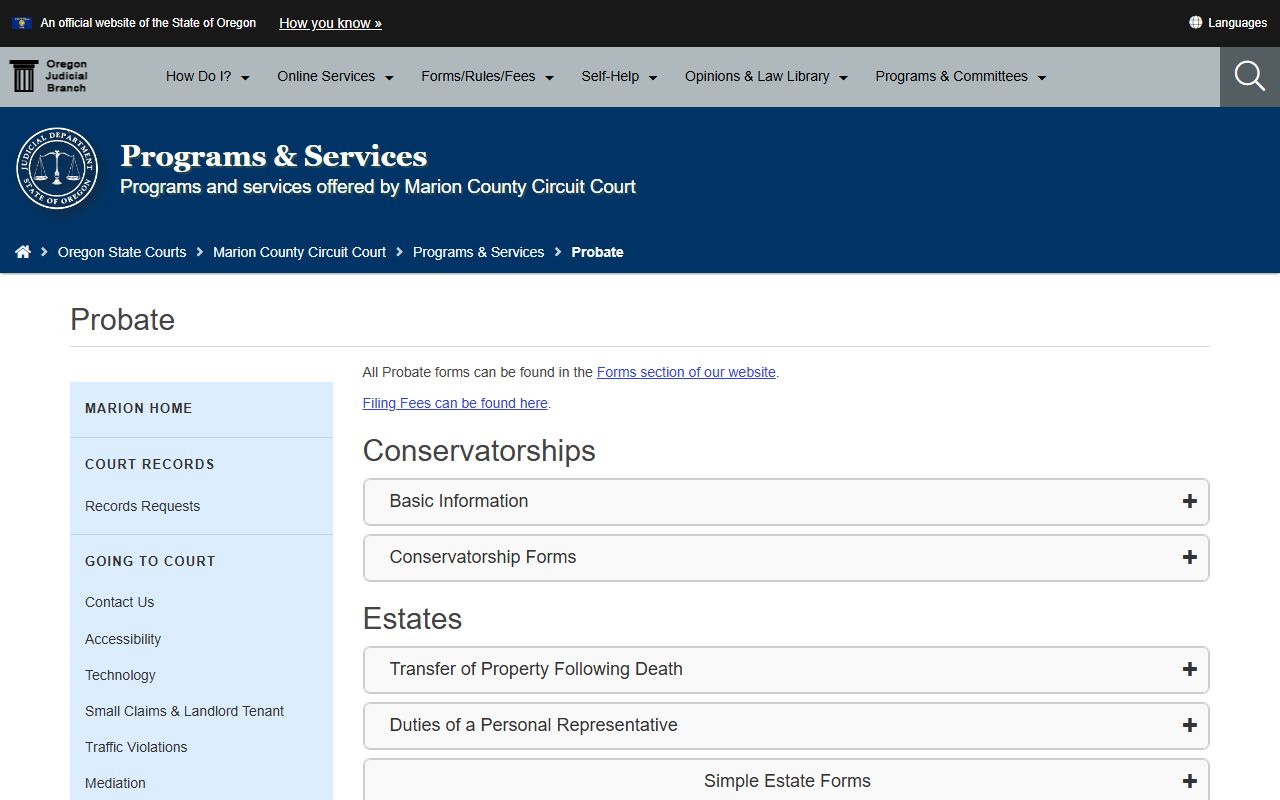
Use that court page for local probate routing, then use OJD search or the records office for case lookup and copies.
Probate Terms Defined
Probate filings use several terms that describe the person who died, the protected person, and the fiduciary appointed by the court. The exact title matters because a will case, estate case, guardianship, and conservatorship can produce different record types.
- Decedent
- The person who died and whose estate may be administered through probate.
- Testator
- A person who made a will.
- Personal representative
- The fiduciary appointed to administer an estate; often called an executor when named in a will.
- Guardian
- A fiduciary responsible for personal care decisions for a protected person.
- Conservator
- A fiduciary who manages and safeguards a protected person's property.
- Inventory
- A filing that identifies property or estate assets under court supervision.
- Accounting
- A fiduciary report showing how money or property was handled.
How to Search Marion County Probate Records
Start with the Oregon Judicial Department's statewide search paths because Marion probate cases are Circuit Court cases. The free records and calendar search may show basic case information when available. OJCIN/OECI provides fuller Register of Actions access for subscribed users. The local Records Department handles copies and older records that are not fully available online.
A probate search usually works best when the requester separates three tasks: locating the case, reading the Register of Actions, and ordering document copies. The register can identify filings, hearings, notices, appointments, orders, and judgments, but it is not the same as the will, inventory, accounting, or guardianship order itself. If the free OJD search is unavailable or does not show the needed detail, OJCIN/OECI may provide the fuller event log, and the Marion Records Department can help with copy requests once the case is identified.
For guardianship and conservatorship matters, names may not be the only useful search clue. The protected person's name, fiduciary name, filing year, case number from court papers, and document title can all matter. When a file involves a protected person, minor, adoption-related material, mental health issue, or sealed filing, public search may show little or nothing even when a case exists. In that situation, the next step is not a broader internet search; it is a records access question to the court.
- Search OJD's Find a Case or Court Record guidance to understand whether the probate case is searchable online.
- Use free OJD records and calendar search for basic case information, checking any service-status notices.
- Use OJCIN/OECI if a complete Register of Actions is needed and a subscription is available.
- Request copies from Marion Circuit Court Records Department with the case number and exact document names.
- For older probate research, check the Oregon Secretary of State Marion County inventory and ask court staff about microfilm or archive locations.
Probate Copy and Request Pathway
The research file identifies statewide probate filing fees as linked from the court's probate page, but it does not provide a Marion-specific probate filing amount. The safe fee details available for this page are the Circuit Court copy costs used when requesting probate case documents from the Records Department.
Copy requests should name the exact probate document whenever possible. Useful examples include petition for appointment, letters, will, inventory, annual accounting, guardian report, conservator report, order appointing fiduciary, order approving sale, final accounting, or judgment closing the estate. A request for "everything" can require staff review, confidentiality screening, and a larger page count, especially in guardianship or conservatorship files where protected information may be present.
| Request item | Amount or path |
|---|---|
| Probate filing fees | Use OJD statewide filing fee schedule linked from the probate page. |
| Paper standard copy | $3.00 plus $0.25 per page |
| Paper certified copy | $5.00 plus $0.25 per page |
| Paper exemplified copy | $10.00 plus $0.25 per page |
| Electronic standard copy | $3.00 per request |
| Electronic certified copy | $5.00 per request |
| Electronic exemplified copy | $10.00 per request |
| Mailed delivery | Actual cost |
Oregon's guardianship and conservatorship statutes are central to many probate records.
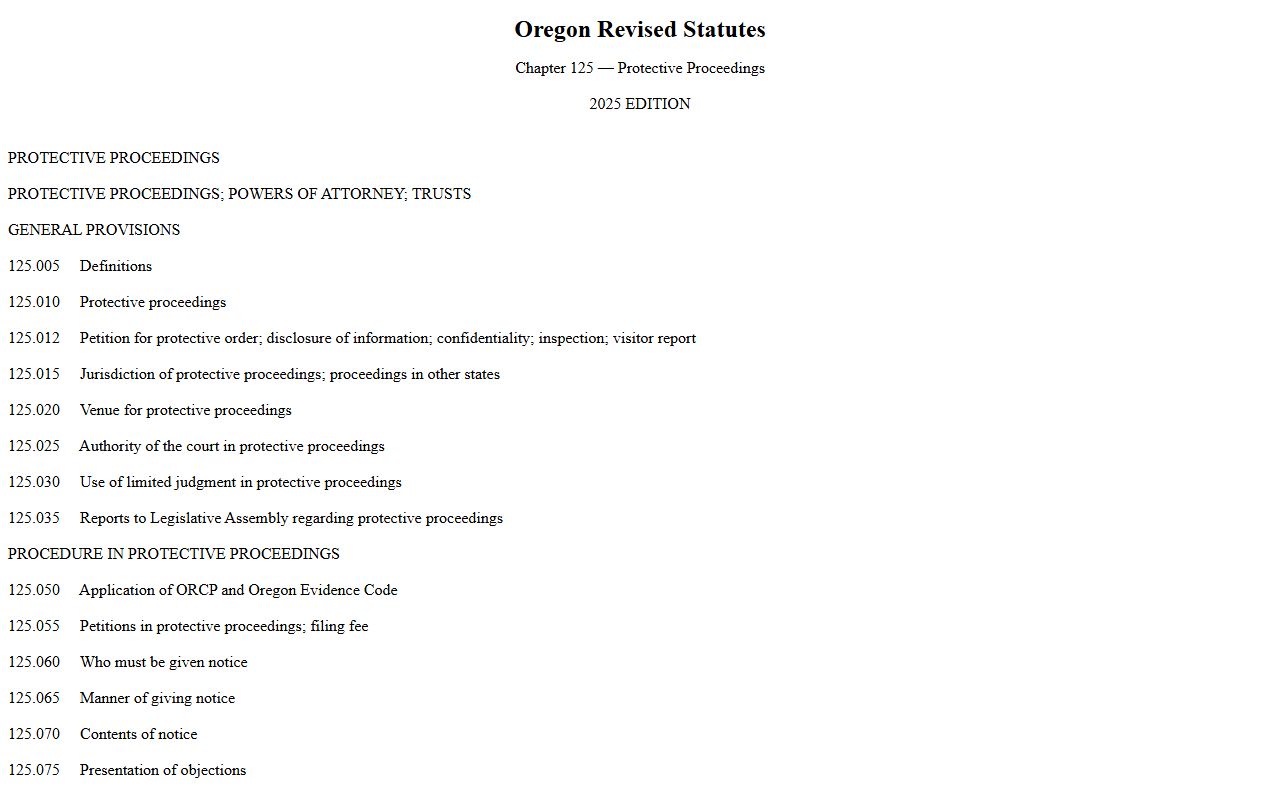
That statute context helps explain why conservatorship files often include duties, reports, inventories, and court supervision records.
Conservator Duties and Fiduciary Training
Marion's probate page says a conservator undertakes serious duties required by Oregon law. A conservator must promptly report changes of name, residence, or mailing address; follow conservatorship law; take immediate control of and safeguard the protected person's property; and keep estate money or property separate from the conservator's own property.
ORS Chapter 125 governs Oregon guardianships and conservatorships. Marion also notes a local fiduciary training requirement. Since March 1, 2017, non-professional fiduciaries appointed by the court must attend training through Guardian Partners unless the court allows online attendance or hardship arrangements. Those training and duty rules are not just process details; they explain why probate records may contain appointment orders, fiduciary reports, inventories, accountings, notices, and compliance filings.
Because a conservator controls another person's property, the case record can document continuing supervision rather than a single appointment event. A reader may see orders that define authority, filings that report assets, notices about address changes, records of money management, and accountings that show whether estate property stayed separate from the fiduciary's own funds. These records can be important for family members, successor fiduciaries, title questions, and later court review, but access may still be limited when the protected person's private information is involved.
The Marion adult treatment courts page appears in the probate manifest and reflects the broader Circuit Court program-services area where probate is listed.
Probate is a separate program area, but both sit within Marion County Circuit Court rather than a county recorder or municipal court.
What Marion County Probate Records Show
Probate records can show petitions, wills, estate inventories, personal representative appointments, guardianship orders, conservatorship orders, accountings, fiduciary reports, protected-person property records, notices, objections, hearings, judgments, and final orders. The online register may show events, but copies of actual documents require a records request.
For a copy request, the strongest identifiers are the probate case number, party or protected-person names, the filing year, and exact document names. If the probate case is older or not digitized, the Records Department may need to consult microfilm, physical files, or archive references. Marion Circuit Court reports records from 1987 to the present in physical or digital form and limited pre-1987 records back to 1910 in microfilm.
Older Probate Archives
Historical probate searches can move beyond current OJD search. The Oregon Secretary of State Marion County inventory identifies older probate case files, indexes, microfilm, and archive locations. The research notes closed probate card indexes around 1911 to 1986 and probate case file ranges from 1942 to 1985. That archive context is especially useful for genealogy, estate-chain research, and older guardianship or conservatorship work.
Do not assume an older probate record is missing because it is not in a modern portal. Use the court records office for court-held files and the Secretary of State inventory for historical location clues. County Clerk archives may help with marriage, deed, and commissioners journal history, but court probate files remain court records unless an archive inventory directs otherwise.
Older probate research may require more than one index because Marion County has long historical continuity across court and county record systems. A will or estate file may point to deeds, marriage records, commissioners court journals, or archived county materials, while the probate case file itself may sit with court records, microfilm, or an archive location. Researchers should keep separate notes for case number, decedent or protected-person name, year range, archive series, and the office contacted so that a later copy request is specific enough for staff to act on.
Restricted Probate Division Records
Not every probate-adjacent record is public. Guardianships and conservatorships can include protected-person details, financial accounts, health information, minor information, protected addresses, and other sensitive data. Juvenile-adjacent records are especially restricted. Adoption records are restricted, and OJD excludes juvenile, mental health, and VAWA-covered cases from free public records and calendar display.
ORS Chapter 419A covers juvenile court records and confidentiality rules. Sealed or confidential probate-related material may require legal authority, party status, or a court order before inspection or copying. When a probate request may involve a minor, protected person, adoption, mental health matter, or sealed filing, contact the Records Department before relying on online search results.
Juvenile confidentiality statutes help explain why some probate-adjacent records will not appear in ordinary public search.
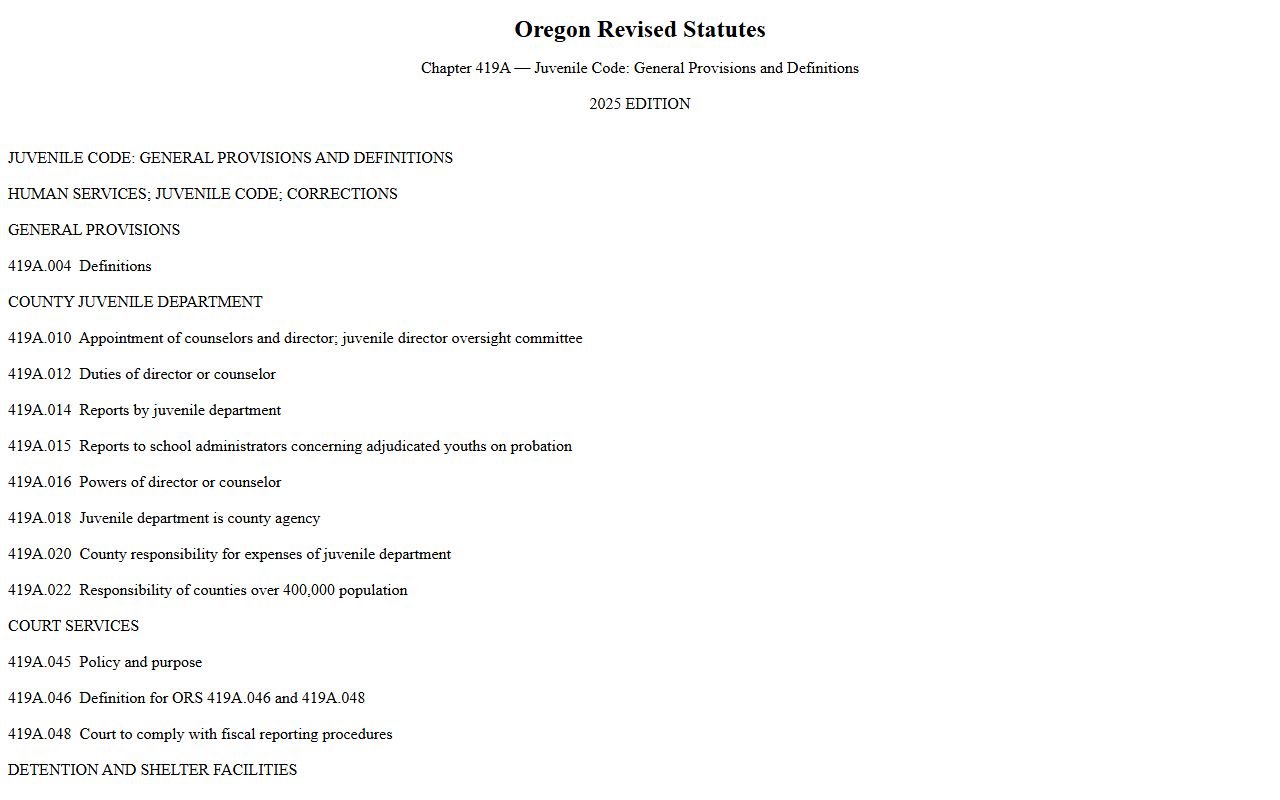
That access limit is part of the probate search pathway when guardianship, protected-person, or juvenile-related material is involved.
Public Record Search
Sponsored Results